
You planned the perfect family trip. You booked the flights and found a great place to stay. But a feeling of dread creeps in. How will your baby handle the time change? The thought of a screaming, overtired child ruining your vacation is a common fear for parents. It can make you question if traveling is even worth the effort.
Take a deep breath. While you cannot completely eliminate jet lag, you can absolutely manage it. With a clear plan, you can help your baby adjust to a new time zone quickly. This guide removes the guesswork. It gives you a simple, step-by-step plan to follow.
Here, you will find a 3-day action plan for your arrival. We also cover how to get back on track when you return home. These tips will help you and your baby enjoy your travels with less stress and more sleep.
Understanding Your Opponent: What Jet Lag Does to Your Baby's Brain
Jet lag is more than just feeling tired. It is a temporary sleep disorder. It happens when you travel across multiple time zones. This travel desynchronizes your baby’s internal body clock. This clock is also known as the circadian rhythm. It tells your baby when to sleep, wake, and eat. When the sun outside does not match their internal clock, confusion happens. This leads to a cranky baby and exhausted parents. For babies, this disruption affects not just sleep, but also their hunger cues and overall mood. Their whole world feels off-kilter, which can be very distressing for them.

Think of your baby’s body having an invisible clock. This clock is used to sleeping during your home's nighttime. When you fly to a new city, the clock is still ticking on the old time. Your goal is to gently help their clock reset to the new local time. The most powerful tool for this is light. Sunlight is like a big reset button for this internal clock. Getting your baby into bright, natural light in the morning tells their brain, "This is the new morning!" This simple act is the foundation of helping them adjust. It signals the start of the active day and helps suppress the hormones that make us sleepy. In the evening, darkness sends the opposite signal, telling their brain it's time to produce melatonin and prepare for sleep.
It is important to know that you should not use over-the-counter melatonin for your baby. Many parents wonder about this as a quick fix. However, the American Academy of Sleep Medicine advises caution. Melatonin is not recommended for children under 3 years old without a doctor's direct guidance. These supplements are not regulated. Dosages can be wrong and potentially harmful. In some kids, it can even have the opposite effect and make them more hyperactive. Instead, focus on natural methods like light exposure and routine to help your baby's body produce its own melatonin at the right time. Patience and consistency are your best allies in this process. Recovery usually takes about one day for every time zone crossed. For a baby, this can mean a few days to a week to feel fully adjusted.
The First Big Decision: Adjust Schedule or Stay on Home Time?
Before you fly, you need a strategy. The right approach depends on your trip's length and the number of time zones you cross. Choosing the correct plan from the start can make a huge difference. It removes stress because you have a clear path to follow from the moment you land. For some trips, it is better to not adjust at all. For others, a full adjustment is needed for everyone's sanity. This decision framework helps you choose the best path for your family.

Use this simple table to decide your strategy. This is the first step in creating a smooth travel experience. By planning ahead, you can feel confident in your approach and focus on making memories instead of managing meltdowns. Remember, the goal is to make the trip enjoyable for everyone, and that starts with a good sleep plan.
| Trip Details | Recommendation | Why? |
|---|---|---|
| Short Trip (< 4 days) & Small Change (< 3 time zones) | Stay on Home Time | Less disruptive than adjusting and re-adjusting in a short period. A 7 PM bedtime at home becomes a 9 PM bedtime two zones east, which can be manageable. |
| Long Trip (> 4 days) OR Big Change (> 3 time zones) | Adjust to Local Time | Necessary for the baby (and you) to function and enjoy a longer trip. Your goal is to fully integrate into the new destination's rhythm. |
If you decide to stay on home time, you will live in a bit of a bubble. For example, on a 4-day trip from San Francisco to Chicago (a 2-hour difference), keeping your baby on Pacific Time means their 7 PM bedtime is 9 PM in Chicago. This might work well if your family activities are in the evening. The downside is that your baby might wake up later in the morning, potentially affecting morning plans. The benefit is that the return trip is seamless, with no adjustment needed. This strategy works best when you can control your schedule and don't have early morning commitments at your destination.
The 3-Day Arrival Plan: Conquering Jet Lag at Your Destination
You have arrived. Now the real work begins. This three-day plan is your road map. It is designed to be a clear, actionable guide that reduces stress. Instead of guessing what to do, you can follow these steps. The key is to manage light, food, and sleep in a coordinated way. We have broken the plan down by the direction of travel. This is because the challenges are different when flying east versus west. Following this plan will help synchronize your baby's internal clock to the new time zone as smoothly as possible. Remember to be patient with your baby and yourself. It is a process, and every small step forward helps.

Strategy 1: Traveling East (e.g., US to Europe) – "The Harder Direction"
Traveling east is generally harder for both babies and adults. You are fighting against your body's natural rhythm. It is like trying to go to bed much earlier than you are used to. Forcing sleep when the body isn't ready is a battle you will likely lose. For example, if you fly from New York to Italy, there is a 6-hour time difference. Your baby's 7:30 PM bedtime at home is now 1:30 AM in Italy. Expecting them to sleep at 7:30 PM local time on the first night is unrealistic. This feels like the middle of the afternoon to their body. The key is to gradually shift their schedule.
The following plan helps you manage this difficult adjustment. It focuses on survival for the first day and then a gradual shift. You will use light, activity, and a slightly later bedtime to gently nudge their internal clock forward. It's helpful to have a detailed Baby Jet Lag Sleep Plan to guide you through the process, but these daily steps provide a strong foundation.
Day 1: Arrival & Survival
- Upon Arrival: Try to land in the afternoon. Do not go straight to a dark hotel room for a long nap. Instead, get outside. Go for a walk and expose your baby to at least 20 minutes of sunlight. This is the strongest signal to their brain that it's daytime.
- Afternoon Nap: Your baby will be tired. Allow a catch-up nap. However, you must wake the baby after about 2 or 2.5 hours. A long nap will steal sleep from the night ahead.
- Evening: Keep the lights in your room bright. Eat a protein-rich meal. Start your normal bedtime routine, but do it much later than usual. Aim for a 9 PM or 10 PM local time bedtime. Do the full routine (bath, book, song) to send strong sleep cues.
- Night Waking: Your baby will likely wake up in the middle of the night, wide awake. If they wake at 2 AM ready to play, keep the lights OFF. Interaction should be minimal and boring. Treat it as a night waking, not a new day. You can offer a small, bland snack if they seem hungry, but then it's back to the crib.
Day 2: The Big Push
- Morning: Wake your baby by 8 or 9 AM local time. This is important even if they had a very rough night. Open the curtains immediately. Get that bright, natural light into their eyes to reinforce the new morning time.
- Naps: Try to follow your baby's usual nap schedule. If they normally nap at 9:30 AM and 1 PM at home, aim for those times in the new location. You must manage nap lengths. Do not let any single nap go longer than 2-3 hours to protect nighttime sleep.
- Bedtime: Move bedtime earlier than last night. Aim for 30-60 minutes sooner. If bedtime was 9:30 PM on night one, try for 8:30 or 9:00 PM on night two. Continue with your consistent bedtime routine.
Day 3: Finding a Rhythm
- Morning: Wake your baby by 8 AM local time. Get outside for morning light again. Consistency is key.
- Naps: Naps should start to feel more predictable. Continue to cap the last nap of the day to ensure they are tired enough for bedtime.
- Bedtime: Aim for your desired local bedtime tonight, such as 7:30 PM. By the third night, their internal clock has made a significant shift, and this should be achievable.
Strategy 2: Traveling West (e.g., US East to West Coast) – "The Easier Direction"
Traveling west is usually an easier adjustment. Your body's natural tendency is to drift toward a longer, 25-hour day. This means staying up a little later is more natural than forcing sleep earlier. When you fly from the East Coast to the West Coast of the US, you are essentially just asking your baby to stay up a few hours past their normal bedtime. The main challenge is preventing extreme overtiredness as you stretch their day.
Your primary goal is to keep your baby awake until a reasonable local bedtime without them having a complete meltdown. This often requires a strategic, short nap in the late afternoon. Unlike eastward travel, you can often jump right into the new schedule much faster. The adjustment period is typically shorter, but the first day can be tricky. Here is how to handle it.
Day 1: Arrival & Stretching the Day
- Upon Arrival: Get into the afternoon sun. Light exposure in the late afternoon helps to delay the body's natural release of melatonin. This will help push their internal clock back.
- Late Afternoon: This is the danger zone. Your baby's body will be screaming that it's bedtime. Around 4 or 5 PM local time, you may need a short "cat nap." This 30-45 minute nap can be a lifesaver. It gives them just enough rest to make it to a 7 PM or 8 PM bedtime without becoming overtired.
- Bedtime: Stick to a normal local bedtime, like 7:30 PM. Use your full, consistent bedtime routine. Make the room as dark as possible to signal that this is the real bedtime.
Day 2 & 3: Solidifying the Schedule
- Morning: Your baby may wake up very early, for example, at 4 AM. Their body thinks it's 7 AM. Do not start the day. Keep the room dark and treat it like a middle-of-the-night waking. Try to keep them in the crib until at least 6 AM local time.
- Naps & Bedtime: After that first early morning, jump directly into your normal nap and bedtime schedule based on the new, local time. The adjustment when traveling west is typically much faster. You should find that by day two or three, your baby is largely on track.
Your Essential Jet Lag Toolkit: What to Pack
Packing the right gear can make a huge difference in how well your baby handles jet lag. Your goal is to control their sleep environment and provide comfort. A few key items can help you stick to the plan and create a familiar sleep space, even thousands of miles from home. Think of this as your jet lag first-aid kit. Having these items on hand will give you the tools you need to manage light, sound, and comfort, which are the pillars of good sleep on the road.
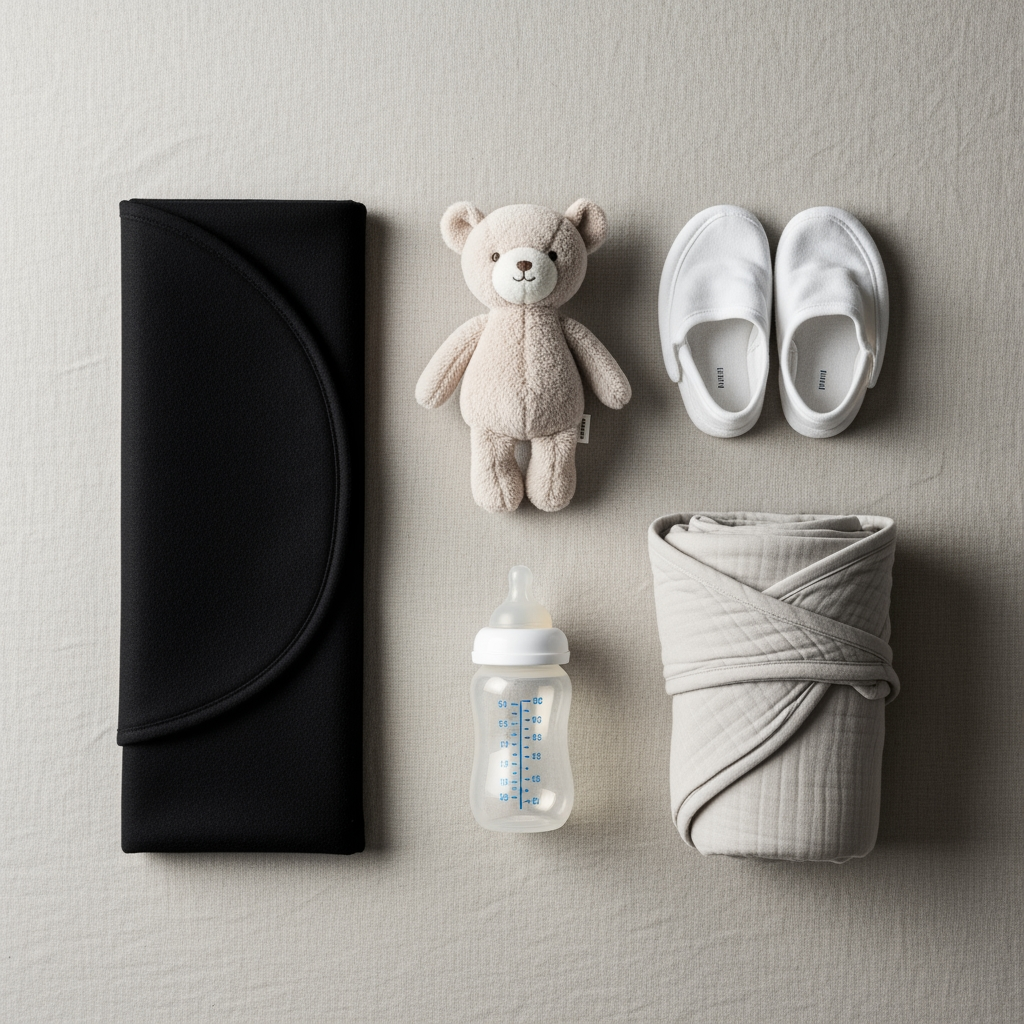
- Portable Blackout Curtains: This is a non-negotiable item. Hotel rooms are notoriously bright. Using blackout curtains for baby sleep helps you control the light. You can make the room pitch black for naps and bedtime, and block out early morning sun.
- Portable Sound Machine: A sound machine drowns out unfamiliar hotel noises like hallway chatter or elevators. It also acts as a powerful sleep cue, recreating the sound environment of their room at home.
- Familiar Comforts: Bring a crib sheet from home, their favorite sleep sack, and a lovey. Familiar smells and textures are calming. Adhering to travel crib best practices by creating a safe and recognizable sleep space can significantly ease the transition.
- Snacks, Snacks, Snacks: A jet-lagged baby's hunger clock is also off. Hunger can wake them at odd hours. Pack plenty of bland, easy-to-digest snacks to handle those middle-of-the-night hunger pangs without starting a party.
- Baby Carrier/Stroller: These are essential for two reasons. They allow for on-the-go naps while you are out exploring. They also help you get that crucial sun exposure without having to hold your baby the entire time.
The Return Home: How to Get Back on Track in 3 Days
Many parents find that the jet lag coming home is even worse than on arrival. You are exhausted from your trip, and now you have to face readjusting to your home time zone. The good news is that you are on home turf. You have more control over your environment. The strategy for returning home is less about gentle easing and more about a firm, quick reset. You need to get back to your normal routine as fast as possible. This might feel tough for a day or two, but it is the quickest way to get your family's sleep back on track.

How do you get a baby back on schedule after vacation? It requires a disciplined approach. The key is to send clear, consistent signals to your baby's brain about what time it is. Do not bring the vacation schedule home with you. Here are the essential steps to follow from the moment you walk through your door.
- Jump Right In: The moment you get home, revert to your home time zone for everything. This includes meals, naps, and bedtime. If you land at 3 PM, and your baby's nap is usually at 2 PM, you have missed it. Push through to an early bedtime instead.
- Control the Light: Use your tools. Get bright morning sunlight to reset their clock. Make their room completely dark for naps and at night. This reinforces your home schedule's light-dark cycle.
- Limit Daytime Sleep: For the first few days back, you may need to wake your baby from naps. This is crucial for building up enough sleep pressure for them to be tired at their normal bedtime. A long afternoon nap will sabotage your efforts for a good night's sleep.
- Be Firm on Early Wakings: This is the hardest but most important step. If your baby wakes at 3 AM, which might have been a reasonable morning time on vacation, do not start the day. Keep the room dark and boring. Treat it like a night waking until your desired wake-up time. Consistency here will pay off quickly.
What This Means For Your Family's Sanity
Traveling with a baby is a wonderful experience. It creates memories that last a lifetime. Jet lag is a temporary challenge, not a permanent barrier. By understanding how your baby's internal clock works and having a clear plan, you can take control. You can minimize the disruption and help your whole family enjoy the adventure. The goal is management, not complete elimination. There will likely be a few rough moments.

Remember that consistency is more important than perfection. If one nap goes wrong or one night is terrible, it does not mean your plan has failed. Just get back on track with the next step. Stick to your routines for meals, play, and sleep as much as possible. These predictable patterns provide security for your child in an unfamiliar environment. A few difficult days will not ruin your baby's sleep in the long run, especially if they have a solid sleep foundation at home.
You are now equipped with a strategy. You have a 3-day plan for arrival and a reset plan for your return. You know what to pack and how to make the crucial decision between adjusting the schedule or staying on home time. Go forward with confidence. Your preparation will pay off, leading to a more restful and enjoyable trip for everyone.